
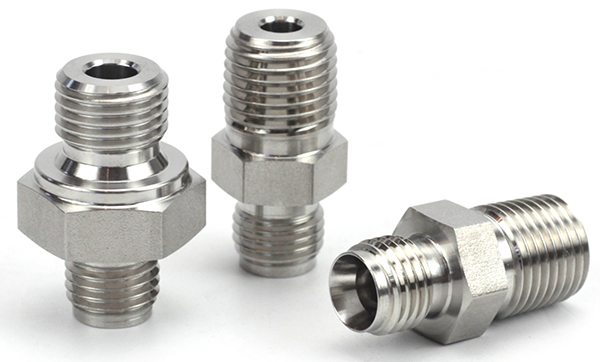
Sesuai namanya, ulir pipa mengacu pada ulir yang digunakan pada pipa. Di sini, pipa mengacu pada pipa nominal. Karena jenis pipa ini disebut pipa nominal, maka ulir pipa sebenarnya adalah ulir nominal. Ulir pipa, sebagai bentuk sambungan pipa, banyak digunakan untuk penyambungan dan penyegelan pipa berukuran kecil dan menengah yang mengangkut cairan dan gas. Ada tiga jenis ulir pipa yang umum. Yaitu: ulir NPT, ulir BSPT, dan ulir BSPP.
Perbedaan utama antara ketiga jenis ulir tersebut adalah:
Ulir Pipa
Sudut
Meruncing/Sejajar
Atas & Bawah
Formulir Penyegelan
Standar
NPT
60°
Meruncing
Bagian atas rata, bagian bawah rata
Pengisi
ASME B1.20.1
BSPT
55°
Meruncing
Bagian atas bulat, bagian bawah bulat.
Pengisi
ISO7-1
BSPP
55°
Paralel
Bagian atas bulat, bagian bawah bulat.
Paking
ISO228-1
Prinsip penyegelan dan metode penyegelan tiga jenis ulir pipa
Baik itu ulir pipa tertutup 55° (BSPT) atau ulir pipa tertutup 60° (NPT), pasangan penyegel ulir harus diisi dengan media selama pengencangan. Umumnya, pita penyegel PTFE digunakan untuk membungkus ulir luar, dan jumlah lilitan bervariasi dari 4 hingga 10 tergantung pada ketebalan pita penyegel PTFE. Ketika celah antara bagian atas dan bawah gigi sejajar, celah tersebut akan mengencang seiring dengan pengencangan ulir pipa. Ulir dalam dan luar ditekan satu sama lain, pertama-tama menghilangkan celah antara sisi yang ditekan. Kemudian, seiring dengan peningkatan gaya pengencangan, bagian atas gigi secara bertahap menjadi lebih tajam, bagian bawah gigi secara bertahap menjadi tumpul, dan celah antara bagian atas dan bawah gigi secara bertahap menghilang, sehingga mencapai tujuan mencegah kebocoran. Ketika ada transisi atau pemasangan interferensi antara bagian atas dan bawah gigi, keduanya pertama-tama ditekan satu sama lain, menyebabkan bagian atas gigi secara bertahap menjadi tumpul dan bagian bawah gigi secara bertahap menjadi lebih tajam, dan kemudian sisi gigi bersentuhan dan secara bertahap menghilangkan celah. Dengan demikian, fungsi penyegelan ulir pipa tercapai.
Ulir pipa interferensi 55° tanpa segel (BSPP) itu sendiri tidak memiliki fungsi penyegelan, dan ulir tersebut hanya berfungsi sebagai penghubung. Oleh karena itu, diperlukan gasket penyegel untuk penyegelan permukaan ujung. Ada dua bentuk penyegelan permukaan ujung: satu menggunakan gasket datar pada permukaan ujung ulir jantan, dan yang lainnya menggunakan gasket kombinasi (gasket elastis yang disinter pada sisi dalam cincin logam) pada permukaan ujung ulir betina.
Untuk detail pemesanan lebih lanjut, silakan lihat pilihan yang tersedia.katalogpadaSitus web resmi HikelokJika Anda memiliki pertanyaan terkait pemilihan produk, silakan hubungi staf penjualan profesional online Hikelok yang beroperasi 24 jam.
As the name suggests, pipe threads refer to the threads used on pipes. Here, pipe refers to the nominal pipe. Because this type of pipe is called a nominal pipe, the pipe thread is actually a nominal thread. Pipe threads, as a form of pipe connection, are widely used for connecting and sealing small and medium sized pipes that transport liquids and gases. There are three common types of pipe threads. Namely: NPT thread, BSPT thread, and BSPP thread.
The main differences between the three types of threads are:
Pipe Thread
Thread Angle
Tapered/Parallel
Crest & Root
Sealing Method
Standard
NPT
60°
Tapered
Flat crest, flat root
Thread sealant
ASME B1.20.1
BSPT
55°
Tapered
Rounded crest, rounded root
Thread sealant
ISO7-1
BSPP
55°
Parallel
Rounded crest, rounded root
Gasket
ISO228-1
Sealing principles and sealing methods of three types of pipe threads
Whether it is a 55° closed pipe thread (BSPT) or a 60° closed pipe thread (NPT), the thread sealing pair must be filled with media during tightening. Generally, PTFE sealing tape is used to wrap the outer thread, and the number of turns varies from 4 to 10 depending on the thickness of the PTFE sealing tape. When the gap between the top and bottom of the teeth is aligned, the gap will tighten as the pipe thread tightens. The inner and outer threads are pressed against each other, first eliminating the gap between the pressed sides. Then, as the tightening force increases, the thread crest gradually becomes sharper, the thread root gradually becomes dull, and the gap between the upper and thread root gradually disappears, thereby achieving the purpose of preventing leakage. When there is a transition or interference fitting between the thread crests and roots, the two are first pressed against each other, causing the thread crest to gradually become blunt and the thread root to gradually become sharper, and then the thread flanks touch and gradually eliminate the gap. Thus, the pipe thread sealing function is achieved.
The 55° interference pipe thread without seal (BSPP) itself does not have a sealing function, and the thread only functions as a connector. Therefore, a sealing gasket is required for sealing the end surface. There are two forms of end surface sealing: one uses a flat gasket on the end surface of the male thread, and the other uses a combination gasket (an elastic gasket sintered on the inner side of the metal ring) on the end surface of the female thread.
For further ordering details, please see the available options in the catalog on Hikelok's official website. If you have any questions regarding product selection, please contact Hikelok's technical sales team, available online 24 hours a day.