
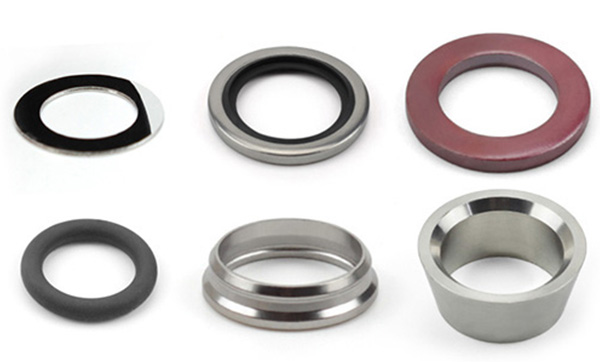
1.Kondisi permukaan dari bidang penyegelan:Bentuk dan kekasaran permukaan dari permukaan penyegelan memiliki pengaruh tertentu pada kinerja penyegelan, dan permukaan yang halus kondusif untuk penyegelan. Gasket lunak tidak sensitif terhadap kondisi permukaan karena mudah berubah bentuk, sedangkan gasket keras sangat dipengaruhi oleh kondisi permukaan.
2. Lebar kontak permukaan penyegelan:semakin besar lebar kontak antara permukaan penyegelan danpakingAtau, semakin panjang jalur kebocoran fluida dan semakin besar kehilangan hambatan aliran, semakin baik penyegelan. Namun, di bawah gaya tekan yang sama, semakin besar lebar kontak, semakin kecil tekanan penyegelan. Oleh karena itu, lebar kontak yang tepat harus ditemukan sesuai dengan material segel.
3. Sifat-sifat fluida:Viskositas cairan sangat memengaruhi kinerja penyegelan kemasan dan gasket. Cairan dengan viskositas tinggi mudah disegel karena fluiditasnya yang buruk. Viskositas cairan jauh lebih tinggi daripada gas, sehingga cairan lebih mudah disegel daripada gas. Uap jenuh lebih mudah disegel daripada uap superpanas karena dapat mengembunkan tetesan dan menghalangi saluran kebocoran antara permukaan penyegelan. Semakin besar volume molekul cairan, semakin mudah terhalang oleh celah penyegelan yang sempit, sehingga mudah disegel. Kemampuan cairan untuk membasahi material penyegel juga memiliki pengaruh tertentu pada penyegelan. Cairan yang mudah meresap mudah bocor karena aksi kapiler dari mikropori pada gasket dan kemasan.
4. Suhu fluida:Suhu memengaruhi viskositas cairan, sehingga memengaruhi kinerja penyegelan. Dengan meningkatnya suhu, viskositas cairan menurun dan viskositas gas meningkat. Di sisi lain, perubahan suhu seringkali mengakibatkan deformasi komponen penyegelan, yang mudah menyebabkan kebocoran.
5. Bahan gasket dan kemasan:Material lunak mudah mengalami deformasi elastis atau plastis di bawah pengaruh beban awal, sehingga menghalangi saluran kebocoran fluida, yang bermanfaat untuk penyegelan; namun, material lunak umumnya tidak dapat menahan pengaruh fluida bertekanan tinggi. Ketahanan korosi, ketahanan panas, kekompakan, dan hidrofilisitas material penyegel memiliki pengaruh tertentu terhadap penyegelan.
6. Tekanan spesifik permukaan penyegelan:Gaya normal pada permukaan kontak unit antara permukaan penyegelan disebut tekanan spesifik penyegelan. Besarnya tekanan spesifik permukaan penyegelan merupakan faktor penting yang memengaruhi kinerja penyegelan gasket atau packing. Biasanya, tekanan spesifik tertentu dihasilkan pada permukaan penyegelan dengan menerapkan gaya pra-pengencangan untuk mengubah bentuk segel, sehingga mengurangi atau menghilangkan celah antara permukaan kontak penyegelan dan mencegah fluida melewatinya, sehingga mencapai tujuan penyegelan. Perlu dicatat bahwa pengaruh tekanan fluida akan mengubah tekanan spesifik permukaan penyegelan. Meskipun peningkatan tekanan spesifik permukaan penyegelan bermanfaat untuk penyegelan, hal itu dibatasi oleh kekuatan ekstrusi material penyegelan; untuk segel dinamis, peningkatan tekanan spesifik permukaan penyegelan juga akan menyebabkan peningkatan resistensi gesekan yang sesuai.
7. Pengaruh kondisi eksternal:Getaran sistem perpipaan, deformasi komponen penghubung, penyimpangan posisi pemasangan, dan alasan lainnya akan menghasilkan gaya tambahan pada segel, yang akan berdampak buruk pada segel. Terutama getaran akan menyebabkan gaya tekan antara permukaan penyegelan berubah secara periodik, dan membuat baut penghubung menjadi longgar, sehingga mengakibatkan kegagalan segel. Penyebab getaran dapat bersifat eksternal atau internal. Untuk membuat segel dapat diandalkan, kita harus mempertimbangkan faktor-faktor di atas dengan serius, dan pembuatan serta pemilihan gasket dan packing penyegel sangat penting.
1. Surface condition of the sealing plane: The shape and surface roughness of the sealing surface have a certain influence on the sealing performance, and a smooth surface is conducive to sealing. Soft gaskets are not sensitive to surface conditions because they are easily deformed, while hard gaskets are strongly influenced by surface conditions.
2. Sealing surface contact width: the greater the contact width between the sealing surface and gasket Or, the longer the fluid leakage path and the greater the flow resistance loss, the better the sealing. However, under the same compressive force, the larger the contact width, the smaller the sealing pressure. Therefore, the correct contact width must be found according to the seal material.
3. Fluid properties: Fluid viscosity greatly affects the sealing performance of packaging and gaskets. High viscosity fluids are easy to seal because of their poor fluidity. The viscosity of liquids is much higher than that of gases, so liquids are easier to seal than gases. Saturated steam is easier to seal than superheated steam because it can condense droplets and block leak channels between sealing surfaces. The larger the volume of liquid molecules, the easier it is to be blocked by the narrow sealing gap, so it is easier to seal. The ability of the liquid to wet the sealing material also has a certain influence on the sealing. Permeable fluids leak easily due to the capillary action of micropores in gaskets and packaging.
4. Fluid temperature: Temperature affects the viscosity of the fluid, thereby affecting the sealing performance. As the temperature increases, the viscosity of the liquid decreases and the viscosity of the gas increases. On the other hand, temperature changes often result in deformation of the sealing components, which easily causes leakage.
5. Gasket and packaging materials: Soft materials are easy to undergo elastic or plastic deformation under the influence of preload, thereby blocking fluid leakage channels, which is beneficial for sealing; however, soft materials generally cannot withstand the effects of high pressure fluids. The corrosion resistance, heat resistance, compactness and hydrophilicity of the sealing material have a certain influence on the sealing.
6. Specific pressure of sealing surface: The normal force on the contact surface of the unit between the sealing surfaces is called specific pressure of sealing. The specific pressure of the sealing surface is an important factor that influences the sealing performance of gaskets or packings. Usually, a certain specific pressure is generated on the sealing surface by applying pre-tightening force to deform the seal, thereby reducing or eliminating the gap between the sealing contact surfaces and preventing fluid from passing through, thereby achieving the purpose of sealing. It should be noted that the influence of fluid pressure will change the specific pressure of the sealing surface. Although increasing the specific pressure of the sealing surface is beneficial for sealing, it is limited by the extrusion force of the sealing material; for dynamic seals, an increase in the specific pressure of the sealing surface will also cause a corresponding increase in friction resistance.
7. Influence of external conditions: Vibration of the piping system, deformation of connecting components, deviation of installation position and other reasons will produce additional force on the seal, which will have an adverse effect on the seal. Especially vibration will cause the compressive force between the sealing surfaces to change periodically, and make the connecting bolts become loose, resulting in seal failure. The causes of vibration can be external or internal. To make the seal reliable, we must consider the above factors seriously, and the manufacture and selection of sealing gaskets and packing is very important.