
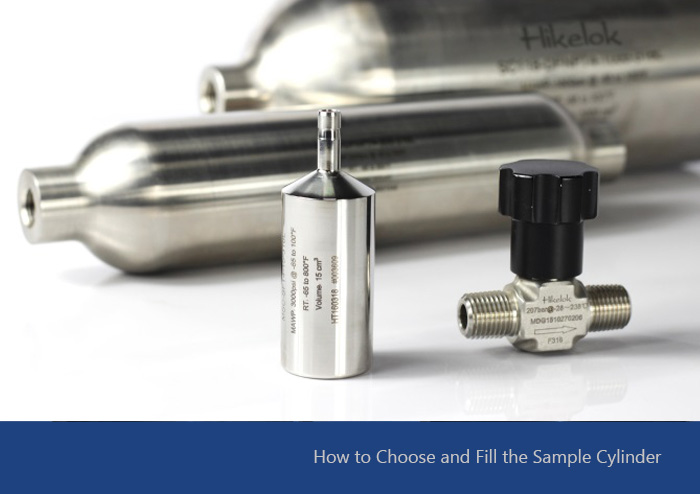
To ensure consistent wall thickness, size, and volume, most sample cylinders are made from seamless tubing. Depending on your sampling application, additional variables should be considered. Work with your cylinder supplier to select the appropriate design. Key characteristics include:
Easy-to-operate quick connector — connects and disconnects safely and efficiently at the sampling point.
Smooth internal neck transition — helps eliminate residual liquid and makes the cylinder easier to clean and reuse.
Suitable material composition and surface treatment — special alloys may be required depending on the gas or liquefied gas being sampled.
Integrated bypass line — helps purge toxic sample residue and improves technician safety. Purge fluid through the quick connect ensures any spill during disconnection is purge fluid, not toxic sample.
Durable design and construction — sample cylinders are often transported long distances for laboratory analysis.
How to fill the sample cylinder correctly
In most cases, sample cylinders should be filled vertically for the following reasons:
For LPG samples, fill from the bottom up so remaining vapor vents through the top (typically via a dip tube). A fully liquid-filled cylinder can rupture if temperature rises unexpectedly. For gas samples, fill from top to bottom so condensate in the line vents from the bottom.